Jonathan Livingston Seagull
Jonathan Livingston SeagullJonathan Livingston Seagull’s decisive pursuit is to make flight more than a means of reaching food: he treats it as a discipline through which a gull can learn, exceed imposed limits, and become free. His path runs from solitary experiments condemned by his flock to a wider understanding of perfection, and finally to a return to Earth—not to reclaim his place in the old community, but to teach those willing to learn.
Identity and Early Experiments
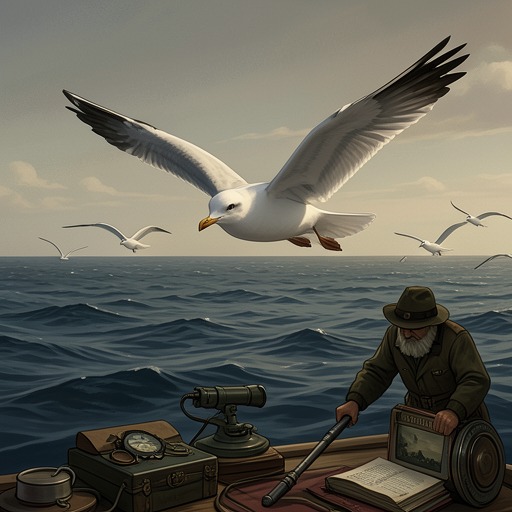
While a thousand gulls gather around a fishing boat for breakfast, Jonathan practices alone beyond the boat and shore. He experiments with a slow, tight curve that makes the wind nearly a whisper and the ocean seem still below him. The maneuver ends in a stall and a fall, a conspicuous failure in a society where a gull’s loss of flight is treated as disgrace. Jonathan nevertheless stretches his wings and tries again; his willingness to repeat what other gulls avoid marks him as different before the flock formally rejects him.
The difference is not simply a taste for unusual maneuvers. Most gulls learn only enough flight to travel between shore and food, because eating, rather than flying, is what matters to them. For Jonathan, flight itself is the object of devotion. He spends whole days alone in low-level glides, learning that when he flies at a height less than half his wingspan above the water, he can remain aloft longer with less effort. His glides finish in a long, flat wake rather than the usual feet-down splash; he also works out feet-up landings on the beach and paces the length of each slide in the sand. His parents are dismayed, while Jonathan continues to treat each adjustment as knowledge worth acquiring.
Technical Learning and the Breakthrough
Speed becomes the next problem. After a week of practice, Jonathan attempts a steep power-dive from a thousand feet. At seventy miles per hour, a wing becomes unstable on the upstroke. His left wing stalls, he rolls violently, and a loss of control spins him into the water. He repeats the attempt ten times, each time crashing, until he identifies a change in technique: flap only to fifty miles per hour, then hold the wings still at high speed.
From two thousand feet, he tests the new method with his wings extended and stable after passing fifty. It takes tremendous strength, but in ten seconds he reaches ninety miles per hour, setting a speed record for gulls. The success is not yet mastery. When he changes the angle of his wings to pull out, he loses control again and strikes the sea with the force of his own high-speed experiment. The breakthrough emerges through that contrast: a record-setting dive can coexist with a dangerous, unsolved problem of control.
Later, he pushes the achievement further. Diving from eight thousand feet, he reaches terminal velocity and records a speed of 214 miles per hour. At 160 miles per hour, he pulls his beak up; only after slowing to twenty does he spread his wings again, with the boat now a crumb four thousand feet below. The height and speed do not end his inquiry. He discovers that moving a single wingtip feather a fraction of an inch produces a smooth curve at tremendous speed, whereas moving more than one can send him spinning like a rifle ball. From there he develops a repertoire of aerobatics, including the loop, slow roll, point roll, inverted spin, gull bunt, and pinwheel. His learning proceeds by testing a movement, reading its consequences, and refining his control—not by assuming that a spectacular result has solved every problem.
Exile and a Changed Understanding of Heaven
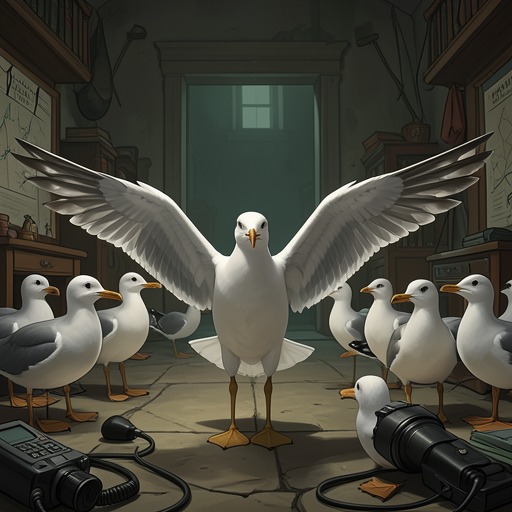
Jonathan returns to the beach expecting the flock to rejoice at what he has discovered. Instead, the gulls have assembled at the Council Gathering and call him to the center. The summons can signify either great honor or great shame; although he wants neither leadership nor a ceremony, he steps forward hoping to share what he has learned. The Elder declares him centered for shame. To Jonathan, the judgment is a shock: he believes his discovery could give gulls a reason to learn and find freedom, while the Council calls his conduct irresponsible and insists that life is for eating and staying alive.
He answers the Council aloud, arguing that a gull who seeks a higher purpose is acting responsibly. A thousand years of scrambling after fish heads, he says, need not be the limit of gull life; learning, discovery, and freedom offer another reason to live. The flock does not engage with his appeal. Its members close their ears and turn their backs, declaring the Brotherhood broken. Exile therefore cuts Jonathan off from the community he hoped to inspire, but it does not make him abandon either flight or the conviction that what he has found can be shared.
In a later stage of learning, his conception of the goal itself changes. When he asks whether heaven is a place, Chiang tells him that it is neither a place nor a time, but being perfect. Speed, Chiang teaches, reaches toward heaven not by accumulating a larger number—whether a thousand miles an hour, a million, or the speed of light—but by becoming perfect speed. The formulation shifts Jonathan’s pursuit from a contest against measurable limits toward a different understanding of arrival and perfection.
Learning from Chiang
Chiang teaches Jonathan that flying as fast as thought, to anywhere, begins with knowing that one has already arrived. The lesson challenges him to stop defining himself as a body trapped by a forty-two-inch wingspan and by performance that can be plotted on a chart. Chiang describes Jonathan’s true nature as perfect and unlimited, present everywhere across space and time. Yet the new idea does not arrive as an instant power: Jonathan practices fiercely from before sunrise until after midnight and, for all that effort, does not move even a feather-width.
Chiang rejects faith as a substitute for understanding. Jonathan did not need faith to fly, he says, but understanding; this new kind of flight requires the same. One day on the shore, Jonathan closes his eyes and suddenly grasps the instruction, recognizing himself as a perfect, unlimited gull. When he opens his eyes, he and Chiang stand on a different seashore, beneath a green sky and twin yellow suns. The change demonstrates that he has begun to act on the idea, though Chiang immediately cautions that his control still needs work. The episode preserves the story’s distinction between a breakthrough in understanding and the practice required to command it.
Chiang’s teaching extends beyond movement through space. He tells Jonathan that time can be studied until he can fly the past and the future, and that the most difficult and powerful lesson will be to know kindness and love. Jonathan learns quickly, but the instruction remains unfinished. Before disappearing, Chiang urges him to continue learning and practicing, and leaves him with a final charge: keep working on love. His departure makes love not a reward that cancels the discipline of flight, but the next discipline Jonathan must pursue.
Return and the Work of Teaching
As time passes in the new world, Jonathan repeatedly thinks of Earth. He imagines how much fuller his earlier life might have been if he had known even a fraction of what he has learned, and wonders whether another gull there is struggling to break out of familiar limits. He also considers that someone may have been made an outcast for speaking a truth the flock did not want to hear. The possibility turns his recollection of exile into a reason to return: he wants to offer another gull the chance to see the truth for himself.
This decision grows alongside his practice of kindness and his effort to understand love. Jonathan recognizes himself as an instructor, and understands teaching as his way of giving something of the truth he has seen to a gull who asks only for the chance to see it. When Sullivan questions the return, Jonathan answers that friendship cannot depend on space and time if they are trying to overcome them. With space overcome, he reasons, all that remains is Here; with time overcome, Now. Their connection need not be destroyed by distance. Sullivan, though doubtful, acknowledges that Jonathan may be able to show a gull on the ground how to see a thousand miles.
Jonathan takes leave of Sullivan while holding in thought an image of great gull-flocks on the shore of another time. He knows himself not as bone and feather but as an idea of freedom and flight, limited by nothing. This understanding gives the return its particular force: he goes back not because exile has been reversed or the old flock has changed, but because knowledge now carries an obligation toward learners who might otherwise face the same isolation. Flight has brought him beyond the boundaries of an individual body; teaching turns that discovery toward other lives.
Narrative Role and Significance
Jonathan’s development links practical experiment to a spiritual and ethical pursuit. At first, the evidence is physical and exact: a glide lasts longer close to the water; wings held still stabilize a fast dive; one feather can guide a curve where several produce a spin. Repeated failures are not incidental to his excellence but part of how he learns. Later, Chiang extends the problem of control from wings and speed to space, time, and the understanding of self. Each change widens what flight can mean without erasing the earlier emphasis on practice.
His conflict with the flock sets individual discovery against a communal code that reduces life to food and survival. Jonathan’s response is not simply to prove that he can fly faster. Even at the moment the Council rejects him, he wants to share what he has found; after learning in another world, he returns because another struggling gull may need a chance to learn. The arc thus makes instruction the practical expression of freedom and love: knowledge matters not only as a personal escape from limits, but as something that can be offered to others without demanding that they accept it in advance.